
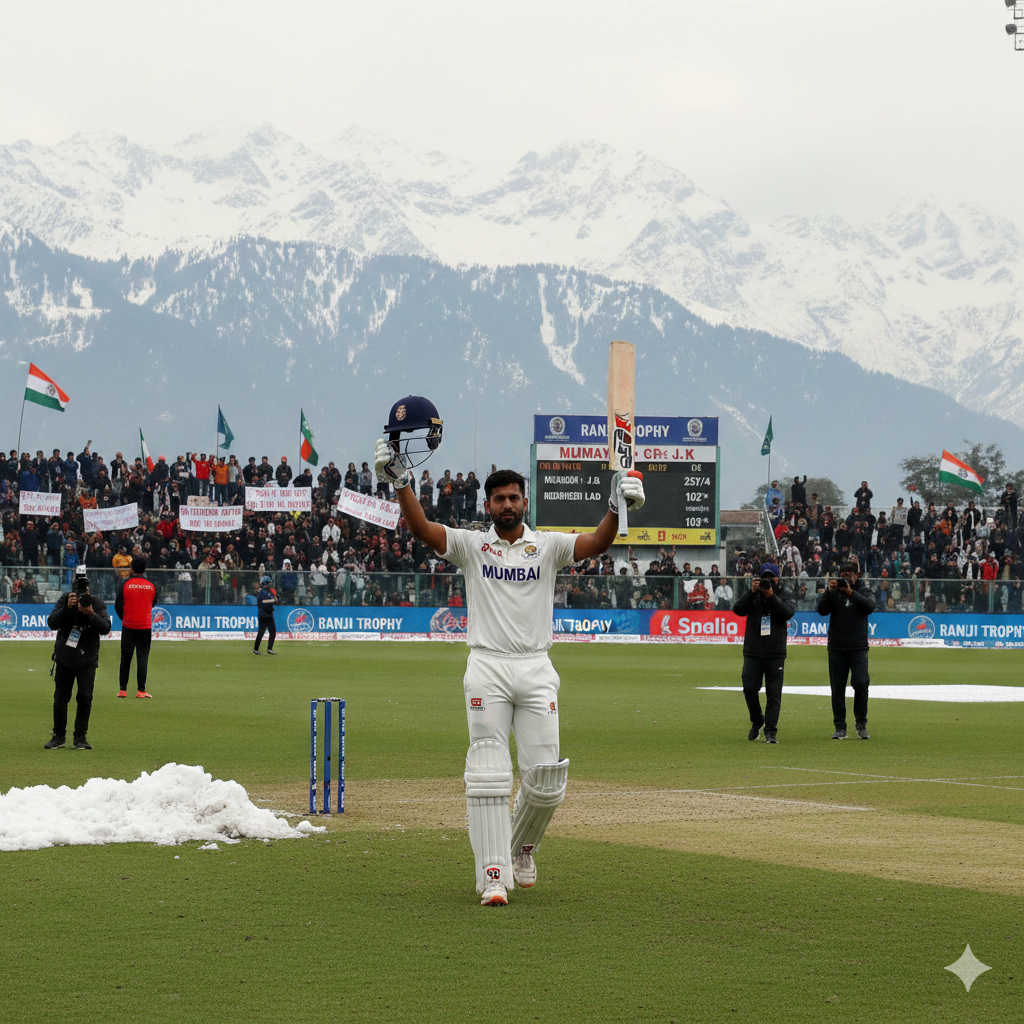
Ranji Trophy: Mumbai’s crisis man Siddhesh Lad stands tall in Srinagar, slams ton vs J&K
In testing conditions and under mounting pressure, Siddhesh Lad once again proved why he is regarded as Mumbai’s ultimate crisis man, producing a magnificent century against Jammu & Kashmir in their Ranji Trophy encounter at Srinagar. On a pitch that demanded patience, technique, and mental toughness, Lad’s resolute knock stood out as a beacon of composure and class. Mumbai found themselves in early trouble after losing quick wickets to a disciplined J&K bowling attack that exploited the morning conditions expertly. With the ball moving off the seam and bounce remaining uneven, the visitors were staring at a precarious situation. It was then that Lad walked in, calm and focused, fully aware of the responsibility resting on his shoulders. Displaying immense maturity, Lad chose restraint over flamboyance in the initial phase of his innings. He left deliveries outside off-stump judiciously, defended with soft hands, and punished loose balls with precision rather than power. His footwork against spin was particularly impressive, as he used the crease intelligently to negate turn and bounce. As the innings progressed, Lad slowly began to assert himself. The drives through cover and mid-off were timed to perfection, while his occasional pull shots showed his growing confidence. Each run was hard-earned, reflecting his understanding of the conditions and the match situation. Partnerships built around his presence provided Mumbai the much-needed stability after early setbacks. The Srinagar crowd witnessed a masterclass in temperament as Lad weathered multiple bowling spells, including reverse swing and disciplined spin from J&K’s attack. His century, brought up with a controlled boundary, was met with understated celebration — a nod to his professionalism and the work still left to be done for the team. This hundred was not just about personal milestones; it was a statement innings. Lad’s knock anchored Mumbai’s innings and shifted the momentum decisively in their favor. It reaffirmed his reputation as a dependable middle-order batter who thrives when the team needs him most. Over the years, Siddhesh Lad has built a reputation for rising to the occasion in pressure situations, and this innings in Srinagar only adds to his growing legacy in domestic cricket. In a match where many struggled for fluency, his ability to adapt and endure underlined his value to the Mumbai setup. As Mumbai eyes another strong Ranji Trophy campaign, performances like these serve as a reminder that experience, grit, and temperament remain invaluable in the longest format of the game. In the cold confines of Srinagar, Siddhesh Lad stood tall — not just as a centurion, but as the backbone of Mumbai’s resilience.
Ranji Trophy: Mumbai’s crisis man Siddhesh Lad stands tall in Srinagar, slams ton vs J&K Read More »